EPDM Roofing for Commercial & Industrial Facilities
Whether you're specifying a new rubber roof or deciding what to do about a 20-year-old EPDM membrane that's opening up at the seams, RPI installs, repairs and restores EPDM across Georgia and South Carolina — commercial, industrial and institutional buildings only. No residential.
The rubber membrane with the longest field history
EPDM — the black synthetic-rubber membrane — has been on commercial low-slope roofs longer than any other single-ply chemistry. It stays flexible through the temperature swings a Georgia or South Carolina roof cycles through every year, takes decades of UV without embrittling, and on a large, simple deck it is still one of the most economical membranes you can put down. RPI installs EPDM in 45–90 mil thicknesses — ballasted, fully adhered or mechanically fastened — as one option in our full single-ply lineup alongside TPO and PVC.
Just as important: we work on the EPDM that's already on your roof. An aging rubber roof is rarely an automatic tear-off, but it needs an honest read of the seams and flashings before you spend money in the wrong direction. Every EPDM conversation with RPI starts with that assessment — request one here.
- New EPDM installs — attachment engineered to your deck type and wind-uplift rating, installed to manufacturer detail.
- EPDM repair — seam, flashing and puncture work that keeps a sound membrane in service instead of forcing a replacement.
- EPDM restoration — fluid-applied coating systems that extend a sound membrane and turn a black roof reflective white.
Repair, restore or replace? How to read an aging EPDM roof
EPDM has a well-known set of failure modes, and nearly all of them show up at the details before the field of the membrane gives out. Here's what we inspect first — and what each finding usually means for your budget:
Where EPDM fails
- Seams. Older EPDM laps were glued or taped, not heat-welded the way TPO seams are. Adhesive laps let go slowly — a fishmouth here, a lifted edge there — and they're the first place water gets into the insulation below.
- Shrinkage. Aging rubber pulls tight, bridging corners and curbs, tenting at penetrations and dragging flashings off the wall. Widespread shrinkage is the clearest sign a membrane is near end of life.
- Punctures and surface wear. EPDM tolerates weather better than foot traffic. Trades servicing rooftop units on a roof without walk pads leave punctures that don't announce themselves until the ceiling stains do.
The three paths forward
- Repair. If the membrane is sound and the failures are local — a few seams, a torn flashing, punctures around a unit — targeted commercial roof repair is the cheapest move and buys real years.
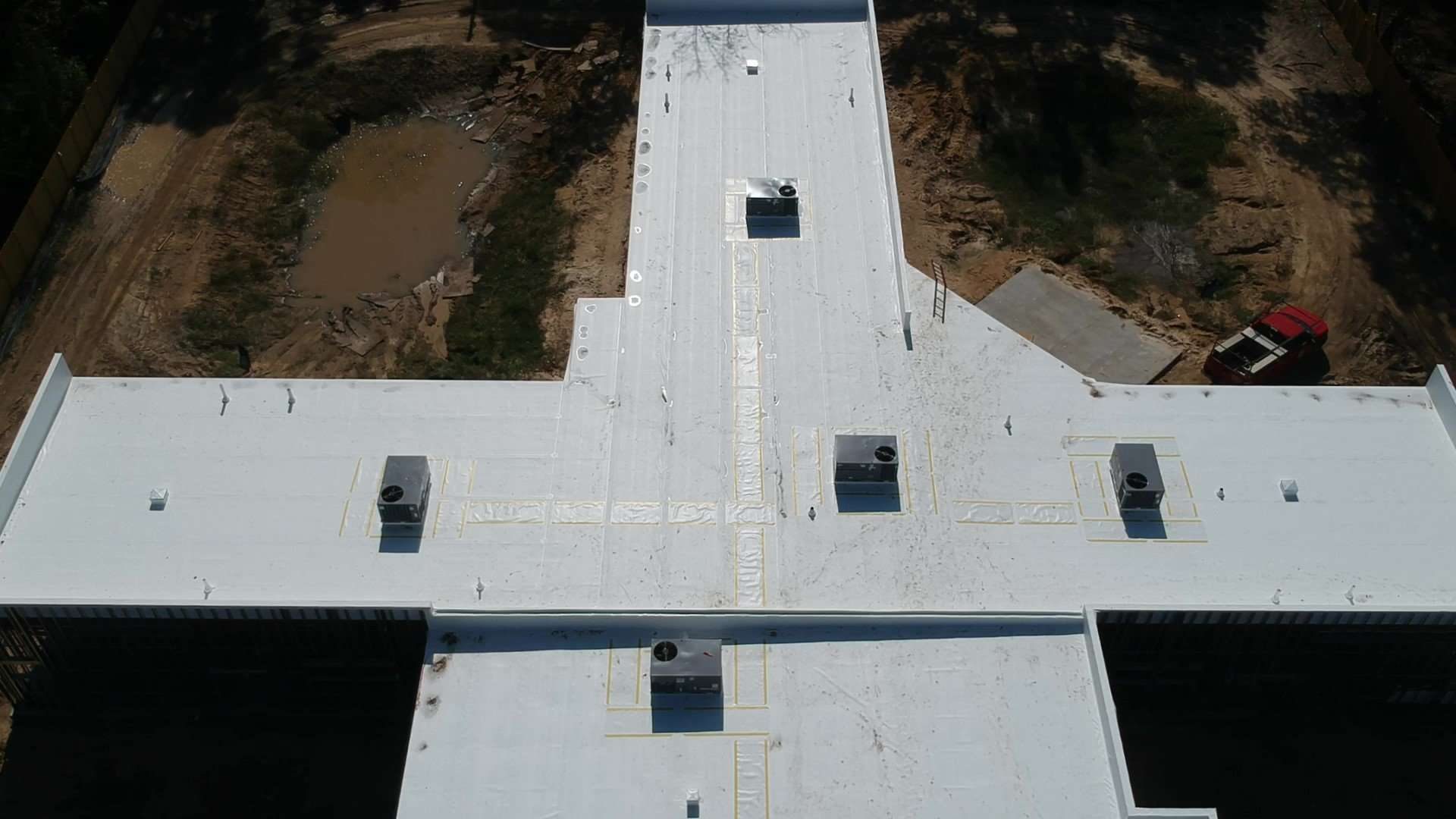
- Restore. If the membrane is broadly intact but aging, and core cuts show dry insulation, a fluid-applied roof coating system reseals every seam, resets the clock without a tear-off, and converts a heat-absorbing black roof into a reflective white one.
- Replace. If shrinkage is widespread or moisture surveys show wet insulation, patching is money thrown after a dead membrane. At replacement, many owners convert to heat-welded TPO for stronger seams and reflectivity — though on a ballasted deck or budget-driven re-roof, new EPDM can still win. We'll show you the math on both.
Black vs. white: the heat-load question
Black EPDM absorbs solar heat instead of reflecting it. Over an unconditioned warehouse or under stone ballast, that barely matters; over conditioned space in a Southeast summer, it drives cooling load every day the sun is out. It's why the reflective-coating and convert-to-TPO conversations usually start with the utility bill, not the leak.
Three ways to put rubber to work
Ballasted EPDM
Loose-laid membrane held down by stone ballast — fast to install and hard to beat on cost for a large, simple, low-traffic deck with the structure to carry the weight. The ballast also shields the rubber from UV and blunts the black-membrane heat load.
Fully-Adhered EPDM
Membrane bonded directly to the substrate for a clean, lightweight assembly with strong wind-uplift performance — the standard call where ballast weight, roof geometry or edge exposure rules a loose-laid system out.
Coating-Restored EPDM
A fluid-applied system over a sound, dry membrane — every seam resealed, the whole roof turned reflective white, at a fraction of tear-off cost. Often the highest-ROI option on an EPDM roof in its second decade.
EPDM credentials you can verify
RPI has done commercial roofing exclusively since 2000 — single-ply EPDM and TPO re-roofs on the warehouses, distribution centers, schools, churches, retail and industrial facilities that keep Georgia and South Carolina running. Crews are self-performed, not subbed out, so the same standard shows up on every deck.
The credentials matter specifically on an EPDM job: RPI is a Carlisle-certified contractor, a Carlisle Perfection Award winner and a Firestone Partner in Quality — recognition from two of the biggest names in EPDM manufacturing. Add GAF Master Elite status, the 2019 Triple Excellence Award and Avetta and ISNetworld memberships, and you have installs that unlock full manufacturer system warranties and clear the compliance bar corporate facility owners require. Full list on our awards and certifications page.
EPDM questions facility managers actually ask
Can my EPDM roof be repaired, or does it need replacing?
It depends on what the seams and the insulation say, not the roof's age. Local seam failures, torn flashings and punctures over dry insulation are repairable; widespread shrinkage or wet insulation means repair money is wasted money. We core-cut and moisture-survey before recommending either — start with a repair assessment.
Should I coat my EPDM roof or convert it to TPO?
If the membrane is sound and dry, a coating restoration costs a fraction of a tear-off, reseals every seam and adds reflectivity. If the membrane or insulation is done, conversion to TPO at replacement gets you heat-welded seams and a white roof in one move. The moisture survey makes this decision for you.
Does a black roof really raise my cooling costs?
Over conditioned space, yes — a black membrane absorbs solar heat that your HVAC then has to remove, all summer long. Over unconditioned warehouse space or under ballast, the penalty is much smaller. That's why we ask what's under the roof before we spec what goes on top of it.
Can you work on an occupied building?
Yes. RPI re-roofs and restores occupied facilities that can't shut down for a day — work is sequenced around your operations, and repairs and coatings in particular are low-disruption. Tell us about your building and we'll plan around it.