TPO Roofing, Installed to Manufacturer Spec
The membrane is half the decision. The other half is who welds it. RPI installs TPO on commercial, industrial and institutional roofs across Georgia and South Carolina — to the manufacturer's published detail, so the warranty holds. Commercial only. No residential.
Why TPO dominates commercial low-slope roofs
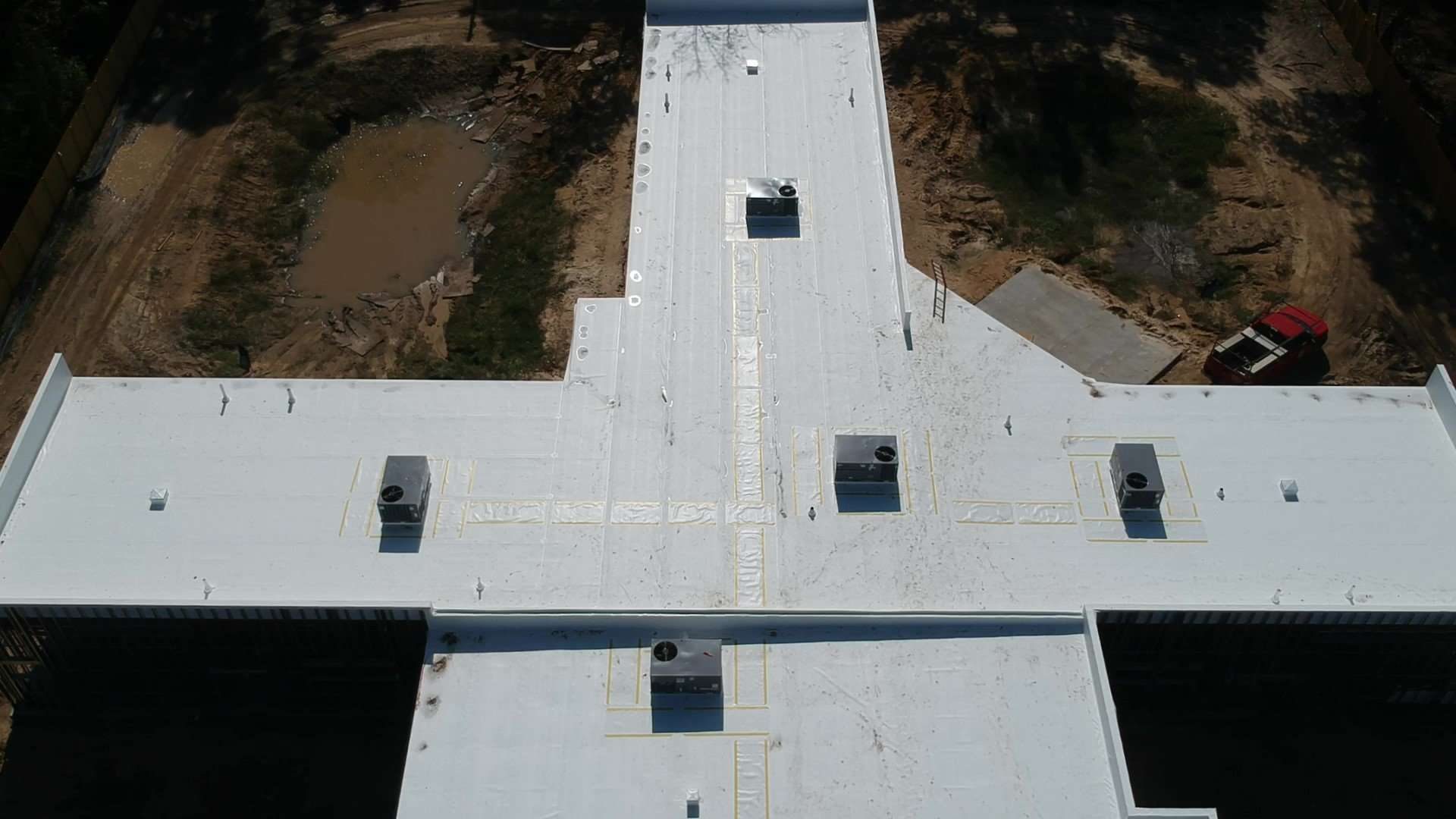
TPO — thermoplastic polyolefin — is a bright-white reinforced membrane whose laps are fused with hot air into one continuous sheet. On a wide, sun-exposed roof in Georgia or South Carolina, that reflectivity cuts the heat your rooftop HVAC fights all summer, and the welded seam removes the failure point that sinks most flat roofs: the lap.
An honest comparison, because TPO isn't right for every building. TPO is usually the best value on warehouses, distribution centers, retail and office roofs where energy performance and cost drive the spec. PVC costs more but outperforms TPO around grease, chemicals and rooftop exhaust — restaurants and healthcare. EPDM gives up reflectivity but stays economical on large, simple roofs. RPI installs all three, so the recommendation follows your building, not our inventory. For the full side-by-side, see our single-ply roofing overview — this page goes deep on TPO alone.
- 45–80 mil reinforced membrane, specified to the warranty term and rooftop traffic it has to carry.
- Hot-air-welded seams — fused, not glued — probe-tested before the crew leaves the deck.
- Every detail to published spec — parapets, drains, curbs, penetrations and edge metal.
Aging TPO roof? Repair, restore or replace — in that order
Most facility managers call assuming they need a new roof. Often they don't. The right answer comes off the roof itself — core cuts, a moisture survey and a walk of every seam, drain and penetration — and it lands in one of three places:
- Repair. Isolated punctures, a failed flashing or a seam that's let go on a membrane that's otherwise sound. We re-weld, patch and re-detail through our maintenance and repair program, and the roof keeps its remaining life for a fraction of replacement cost.
- Restore. The membrane is broadly intact but weathering — surface chalking, seams starting to open, details drying out. A fluid-applied roof coating over prepared TPO can reset the clock and defer a tear-off for years.
- Replace. Saturated insulation, widespread seam failure or a membrane past its service life. At that point a coating is money buried in a failing assembly — a full roof replacement, or a code-compliant recover if the deck is dry, is the honest recommendation.
Whichever it is, you get the answer in writing with the core-cut findings to back it. If the answer is "repair," that's the proposal you'll receive.
Seams & Attachment Options
Heat-Welded Seams
Every RPI TPO system is seamed with hot-air welding: the laps fuse into a single monolithic sheet, stronger than the membrane around them. No adhesives to age, no tape to peel — and every weld is probe-tested.
Mechanically Fastened
Plates and fasteners set inside the laps, engineered to your deck type and wind-uplift rating. The fastest, most economical attachment on large decks — the workhorse spec for warehouses and distribution.
Fully Adhered
Membrane bonded to the substrate across its full area. It costs more, but there's no flutter, a cleaner finished look and stronger performance where wind exposure or appearance rules — offices, schools and high-visibility roofs.
The credentials behind the weld
Anyone can buy TPO membrane. The warranty depends on who installs it. RPI is a Carlisle Certified Applicator — a status Carlisle SynTec grants only after vetting a contractor's training and field performance — and our finished roofs have earned the Carlisle Perfection Award and the 2019 GAF Triple Excellence Award, recognition based on the manufacturers' own inspections of completed roofs. That certification is what unlocks the strongest available system warranties, alongside our GAF Master Elite and Firestone Partner in Quality standing. On the safety side, Avetta and ISNetworld membership means we're already prequalified for the managed industrial and corporate sites that vet contractors before a crew steps on the roof.
That standard has been on commercial roofs since 2000: large-deck single-ply re-roofs on Savannah distribution centers, phased summer-window re-roofs on Columbia school campuses, and low-slope replacements over occupied retail and healthcare buildings in Augusta. See the building types we roof on our projects page, and the full credential list under awards & certifications.
TPO questions facility managers actually ask
How long will a TPO roof last in Georgia and South Carolina?
It depends on membrane thickness, attachment and whether anyone maintains it. What we can say plainly: qualifying assemblies carry manufacturer system warranties of up to 20–30 years covering membrane and labor, and a maintained TPO roof routinely serves the full term.
Can you install TPO over my existing roof?
Sometimes. If core cuts show dry insulation and the assembly qualifies for a code-compliant recover, new TPO over the existing roof avoids tear-off cost and disruption. If the moisture survey finds saturated insulation, a recover just traps the problem — we'll show you the cores and spec a replacement instead.
Is TPO better than EPDM or PVC?
For most warehouses, distribution and retail in our markets, yes — on cost and energy performance. Around grease and chemical exhaust, PVC earns its premium; where reflectivity matters less, EPDM can be the economical call. Compare all three on our single-ply roofing page, or ask us to spec it against your building.
What does the manufacturer warranty actually cover?
Tiers vary. Membrane-only warranties cover material defects; full system warranties cover the membrane and the labor to fix a covered failure. The system tier is only available when a certified applicator installs to published detail and the roof passes the manufacturer's inspection — which is why RPI's certifications matter to your building, not just to our wall. Ready to scope it? Request a quote.